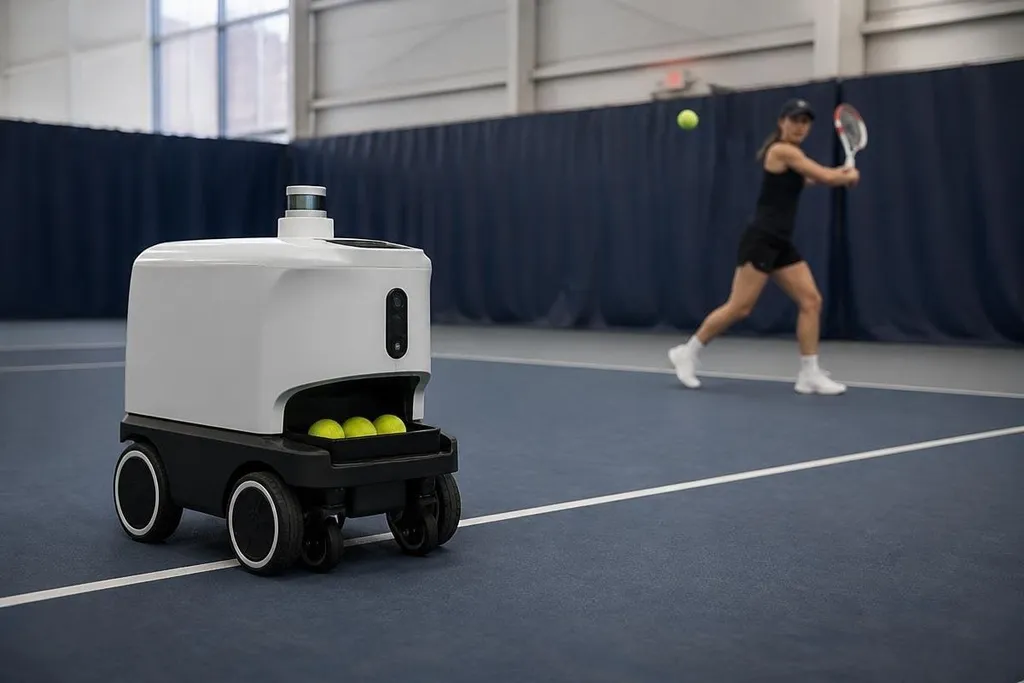
A sports robot can train an athlete, carry equipment, film a match, or handle work around a venue. The business opportunity starts with the task it can repeat safely, not with the shape of its body.
For a sports club, equipment maker, or venue operator, the useful question is simple: who pays, how often, and what work does the robot replace or improve?
Quick read
- Training robots can create income through club packages, rental plans, or paid sessions.
- Venue robots need a clear job, such as moving gear or recording events.
- A robot that needs frequent human control may cost more to run than it saves.
Where the money could come from
Training is the clearest starting point. One system could repeat passes, serve balls, fire shots, or move through set drills at a fixed speed. That gives coaches a repeatable training tool when staff time or practice space is limited.
The buyer may be a club, school, training center, or athlete. Each buyer needs a different offer. A club may pay for a yearly service plan, while an academy may rent the robot by the hour during busy periods.
Rehabilitation is another possible market. Controlled movement systems could guide a patient through the same exercise many times. The sale would depend on safe operation, clear records, and approval for the intended medical use. A sports robot cannot enter this market on a promise alone.
Media and event work could form a separate business. A mobile camera system might follow play from a fixed route, record training sessions, or create views that a person cannot hold for a full match. The buyer would compare the robot with camera staff, rental gear, and the cost of missed footage.
A sports robot that records a match still has to fit the work around the game. Dated sports robot reports from Robot24.com can link its task, venue, date, and staff time to the business case before the next section tests that fit.
The robot has to fit the workflow
A useful sports robot needs more than movement. It needs a place to charge, a trained operator, safe limits around people, and a way to move between tasks. Those needs affect the price of every session.
Take a ball-training robot. Its value depends on setup time, ball loading, target accuracy, and recovery after a fault. If a coach spends 20 minutes resetting the system for a 30-minute drill, the machine may add work instead of removing it.
The same test applies at a venue. Equipment carriers save labor only when they can use lifts, ramps, doors, and storage areas without constant help. A machine that works on a smooth court may struggle on grass, wet ground, steps, or crowded paths.
Data may add another source of income. A system that records shot speed, position, timing, or movement could feed a coaching service. That creates duties around consent, storage, access, and deletion. The data plan needs a named buyer and a clear reason to pay.
What remains unproven
Sports settings are difficult because people move quickly and rules change from one venue to the next. In a test area, the machine can repeat a planned action, yet a live session adds noise, glare, contact, weather, and people crossing its path.
The business case also depends on use hours. A club may accept a high purchase price if the robot runs every day. A smaller buyer may need rental access because the machine sits unused between sessions.
I'd avoid buying a sports robot until the seller shows a full cost for setup, training, repairs, software, insurance, and storage. The hardware price alone tells you little.
A buyer's decision guide
Use these checks before signing a purchase or rental agreement:
- Name the task: write down the exact job, location, session length, and expected result.
- Count human minutes: include setup, loading, supervision, cleaning, and fault recovery.
- Check the space: test doors, floor surfaces, lighting, weather exposure, and safe distance from people.
- Price the service: compare ownership with rental, staff time, repairs, and missed sessions.
- Ask for proof: request an uncut task run in a setting that matches your venue.
- Set the exit rule: define the usage level or result that ends the trial.
The strongest sports robotics businesses may sell access instead of machines. A club could pay for training hours, a venue could buy event coverage, and a coach could subscribe to recorded movement data.
Those offers make the robot part of a service that can be judged by work completed. The next useful proof is not a faster robot. It is a paid trial that shows who uses it, how often it runs, and what the full monthly cost looks like.